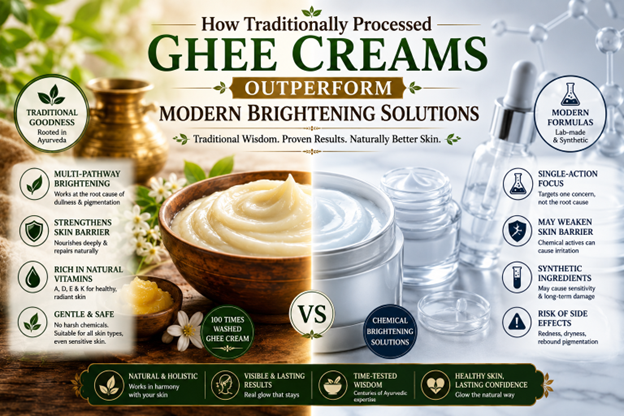
Walk through any pharmacy or beauty store today and you will find an entire section dedicated to brightening. Serums promising visible results in seven days. Creams claiming to deliver glass skin within a fortnight. Acids, enzymes, tyrosinase inhibitors, and synthetic antioxidants all competing for shelf space and consumer trust. And yet — hyperpigmentation, uneven skin tone, and persistent dullness remain among the most common complaints in dermatology clinics worldwide. Perhaps the answer was never in the laboratory at all.
What Modern Brightening Products Actually Do
To understand why traditional preparations outperform synthetic alternatives, it helps to understand exactly how modern brightening products work — and where their limitations lie.
Common modern brightening mechanisms:
- Chemical exfoliants (AHAs, BHAs) strip away the upper layers of skin to reveal fresher cells beneath
- Tyrosinase inhibitors (kojic acid, arbutin, niacinamide) block the enzyme responsible for melanin production
- Synthetic retinoids (retinol, tretinoin) accelerate cell turnover but frequently cause irritation and sensitivity
- Synthetic antioxidants neutralise free radicals but degrade quickly and require chemical stabilisers
The fundamental problem: Each of these mechanisms addresses one aspect of pigmentation. None addresses the underlying causes — oxidative stress, inflammation, compromised cell turnover, and barrier damage — simultaneously. And many create new problems in the process of solving existing ones.
The Specific Drawbacks of Chemical Brightening
Barrier Thinning Repeated use of chemical exfoliants gradually reduces the thickness and integrity of the skin barrier, increasing UV sensitivity and the risk of future hyperpigmentation — the very problem they are meant to solve.
Rebound Hyperpigmentation Tyrosinase inhibitors suppress melanin production while being used. When discontinued, the skin often overcompensates, producing excess melanin and returning to a darker or more uneven tone than before treatment began.
Irritation and Sensitivity Synthetic retinoids and strong acids commonly cause redness, peeling, and photosensitivity — particularly problematic for darker skin tones where irritation itself triggers post-inflammatory hyperpigmentation.
Maintenance Dependency Many synthetic brightening products require ongoing and often escalating application to maintain their effect. The results are cosmetic rather than representing a genuine improvement in skin health.
Why 100 Times Washed Ghee Cream Works Differently
The 100 times washed ghee cream approach to brightening is rooted in a completely different philosophy — one of supporting and improving the skin’s own healthy functioning rather than overriding or suppressing it.
What the preparation delivers:
- Butyric acid — calms the chronic inflammation that triggers and perpetuates post-inflammatory hyperpigmentation
- Natural vitamin A — supports healthy keratinocyte turnover without the dryness and irritation of synthetic retinoids
- Bioavailable vitamin E — integrates directly into the skin’s lipid matrix, providing lasting antioxidant protection that does not degrade within hours
- Natural vitamin D and K — support cell repair and blood vessel health, improving both complexion and skin resilience
The result is a brightening effect that simultaneously strengthens the skin — something no chemical brightener consistently achieves.
How a Brightening Ghee Cream Addresses Pigmentation
A properly prepared brightening ghee cream targets pigmentation through multiple pathways working together, not one mechanism in isolation.
The multi-pathway brightening approach:
Pathway 1 — Gentle Cell Renewal Vitamin A supports the natural shedding of darkened, dead keratinocytes without stripping or irritating the layers beneath. New cells reach the surface in better condition and with more even pigmentation.
Pathway 2 — Oxidative Protection Vitamin E neutralises the UV-triggered free radicals that signal melanocytes to overproduce melanin. By reducing this oxidative stress consistently, the cream prevents new pigmentation from forming while existing spots gradually fade.
Pathway 3 — Inflammation Reduction Any skin trauma — acne, sunburn, friction, insect bites — triggers an inflammatory cascade that can leave lasting dark marks. Butyric acid interrupts this cascade, calming the inflammatory response before it can cause lasting pigmentation changes.
Pathway 4 — Barrier Strengthening A strong, healthy skin barrier is less vulnerable to UV damage and environmental triggers that cause pigmentation. Unlike chemical brighteners that weaken the barrier, 100 times washed ghee cream actively reinforces it.
Side-by-Side Comparison
| Factor | 100 Times Washed Ghee Cream | Chemical Brighteners |
| Primary mechanism | Supports healthy skin biology | Inhibits, strips, or suppresses |
| Skin barrier impact | Strengthened over time | Often weakened with regular use |
| Side effects | Minimal, well-tolerated | Irritation, sensitivity, rebound possible |
| Results timeline | Gradual and lasting | Faster but often temporary |
| Long-term safety | Consistently safe | Requires monitoring and caution |
| Discontinuation | Results persist | Results may reverse or worsen |
| Suitable for sensitive skin | Yes | Often not recommended |
Common Mistakes That Undermine Brightening Results
Even the most effective brightening ghee cream delivers less when paired with habits that continue damaging the skin.
- Skipping sun protection — UV exposure daily undoes weeks of brightening progress; always follow with broad-spectrum SPF during daytime
- Over-exfoliating — weakens the barrier and triggers inflammation that causes more dark spots
- Using high-alcohol products — strips natural oils and compromises the skin environment the cream is working to improve
- Inconsistent application — traditional preparations need consistent daily use to build their cumulative effect
- Expecting results in days — genuine skin brightening through biological mechanisms takes weeks, not days; patience is not optional
What to Expect During the Transition
Many people switch to 100 times washed ghee cream after years of using synthetic actives. The transition period matters.
Weeks 1 to 2: The skin adjusts to the absence of synthetic actives. It may feel different — neither better nor worse immediately. This is normal and temporary.
Week 3: Improved texture, softer feel, and the beginning of a subtle natural radiance become noticeable. The skin starts looking calmer and less reactive.
Weeks 4 to 6: Visible reduction in redness and mild pigmentation. Skin barrier feels stronger and less vulnerable to environmental stress.
Weeks 6 to 8: Significant brightening of dark spots, more even skin tone, and a consistent inner glow that brightens ghee cream users describe as looking genuinely healthy rather than cosmetically treated.
How to Use for Maximum Brightening Results
- Apply morning and night to freshly cleansed skin
- Use on slightly damp skin to lock in surface moisture alongside the cream’s deep nourishment
- For targeted treatment, apply a slightly thicker layer directly on areas of discolouration and leave overnight
- Always follow morning application with broad-spectrum sun protection — this protects the brightening progress
- Support results internally with adequate water intake, antioxidant-rich foods, and reduced sugar consumption
- Commit to at least 8 weeks of consistent use before evaluating results